



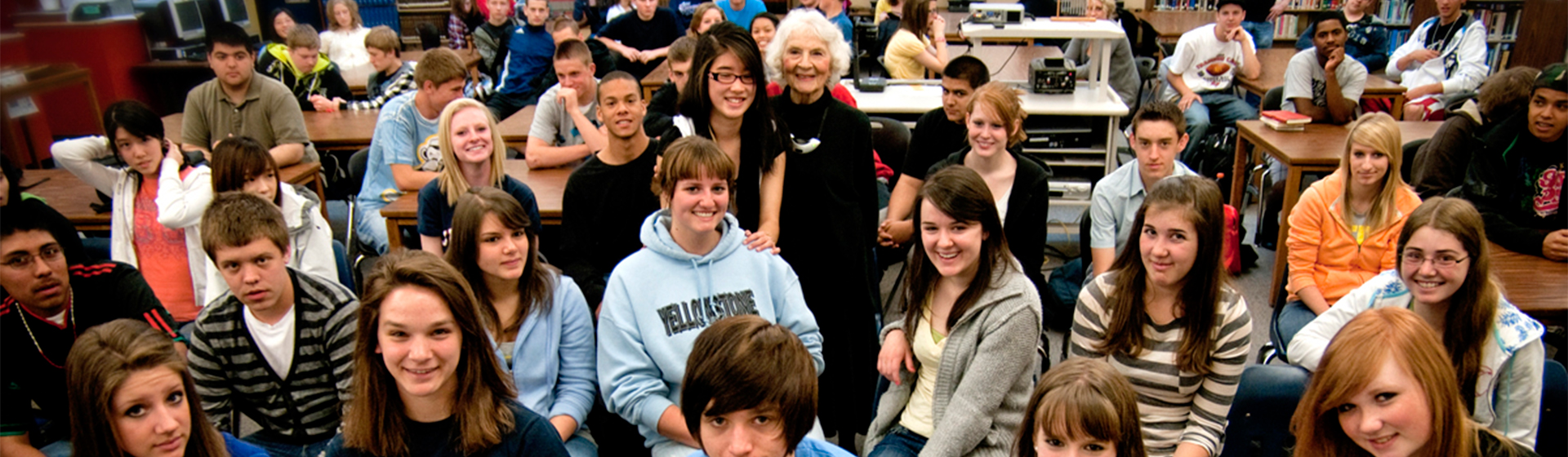

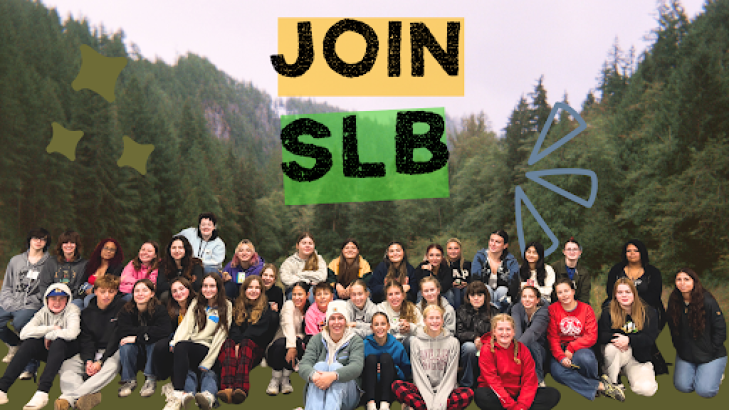
2025-2026 Student Leadership Board cohort.
Student Leadership Board 2026-2027
Applications due by Friday, September 18, 2026
Developing compassionate leaders through education and action | Get involved and make a difference!
Questions? Please contact
Navigate to a section
details & requirements | YOUR LOCAL SLB
Program details
Who should join the Student Leadership Board?
- Students in the state of Washington who are able to attend meetings in person in either Seattle or Spokane
- Grades 7-12
- From any and all backgrounds, ethnicities, and religions
- Passionate and motivated students who want to collaborate on activism, volunteering, and project-based learning
- Students interested to dive deeper to learn about the Holocaust and how they can make a difference today
What does the Student Leadership Board do? What's the commitment?
- For Seattle: participate weekly for the fall and/or winter project (fall project dates: Wednesdays from October 14 – December 9; winter project dates: Wednesday, January 13 – March 10). Students will be able to select one or both sessions on the application form below. The Seattle SLB will meet at the Holocaust Center in downtown Seattle on Wednesday evenings.
- For Spokane: participate in meetings twice a month. These meetings will be in person at Peperzak Middle School, after school.
- Work together to carry out projects that support the Holocaust Center's mission and provide real-world leadership experience
- Volunteer at several Holocaust Center events throughout the year
- Provide feedback on the Holocaust Center's programs and serve as ambassadors
- Hear and learn from community members, Holocaust and genocide survivors and their descendants, and other leaders
- Serve on the Student Leadership Board from October 2026 through May 2027
What are the goals of the Student Leadership Board?
- SLB members will enhance their historical understanding of the Holocaust and other genocides
- Members will collaborate as part of a group or team
- Members will feel empowered, supported, and comfortable assuming a leadership role amongst their fellow SLB members
- Members will be more inclined to speak out or be an upstander if they see a wrong occurring around them
Your Local SLB
SEATTLE
Contact:
SPOKANE
Led by Justin Farley. Justin Farley is a middle school ELA Teacher at Peperzak Middle School (and an AP high school history teacher with Spokane Virtual Academy). He has been in secondary education for nearly a decade (in non-profit and social work for many years before that). He is a husband to an incredibly gifted wife and four wonderful children. Justin has partnered with the Holocaust Center for the last five years and is honored to facilitate the Student Leadership Board for the Spokane Chapter.
This program is made possible thanks to the generous support of George Elbaum and Mimi Jensen, Paul and Leora Bloom, and Errol and Ruth Ann Ger. Special thanks also goes to the Henry M. Jackson Foundation.
A forum for discussions linking lessons from the Holocaust and other genocides with contemporary issues in a legal context. It is comprised of lawyers with a wide range of practice areas, and a common interest learning about the Holocaust.
2025 Legal Committee Members
Steven Beigelmacher, Perkins Coie LLP
Marc Boman (Retired), Preston, Gates & Ellis, LLP
Evan Caplicki, Nossman LLP
Sonja Carlson, Microsoft
Kathy Feldman, Ogden Murphy Wallace
Ronald Friedman, Ogden Murphy Wallace
Deborah B. Josephson, Josephson & Associates
Lucas Michels, Ironmark Law Group, PLLC
Jason Nagel, Judge, Office of Administrative Hearings
Jay Riffkin, Dorsey & Whitney, LLP
Sabina Shapiro, Stoel Rives LLP
Rob Spitzer, Foster Garvey PC
Jeremy Wood, Fisher Phillips
Previous Continuing Legal Education (CLE) Sessions
Understanding the Magnitsky Act in Today’s Climate | Jamison Firestone and Yuliya Ziskina
Profits & Persecution: German Big Business and Nazi Crimes | Peter Hayes, PhD
Hitler's Courts: The Misuse of Executive and Judicial Power | Joshua Green
Restitution After WWII: Suing Hitler's Business Partners | Michael Bazyler
The Crime of Complicity: Law and the Bystander from the Holocaust to Today | Amos N. Guiora
Law as an Instrument of Mass Crimes: The Legal System Under the Third Reich | James J. Grosfeld
If you are interested in joining the Legal Committee of the Holocaust Center, email
This page should be deindexed and not visible in menus. If you found it, please email

John Lynch

Joe Thomas

Jean Torres

Doris Meyer

Ronald Reid
Heading
Some representative placeholder content for the three columns of text below the carousel. This is the first column.
Heading
Another exciting bit of representative placeholder content. This time, we've moved on to the second column.
First featurette heading. It’ll blow your mind.
Some great placeholder content for the first featurette here. Imagine some exciting prose here.
Oh yeah, it’s that good. See for yourself.
Another featurette? Of course. More placeholder content here to give you an idea of how this layout would work with some actual real-world content in place.
And lastly, this one. Checkmate.
And yes, this is the last block of representative placeholder content. Again, not really intended to be actually read, simply here to give you a better view of what this would look like with some actual content. Your content.
Background:
All of these objects have a local connection to Seattle and the Pacific Northwest – either the survivors or their family members live/lived here. Tell the students that each artifact tells a different story, experience, perspective of the Holocaust. All of these stories contribute to, or help define the Holocaust.
Instructions:
Explore the objects in the gallery using the guiding questions. Take notes on your findings. If done with a group, discuss your responses together. Then, view and read the artifact summary. Feel free to explore the full artifact write up and the related Survivor Encyclopedia page. Discuss how your thoughts or feelings about the artifact changed after learning more about it. Did the “story” change your initial thinking about your artifact? If so, how?
For full teacher instructions, please visit here.
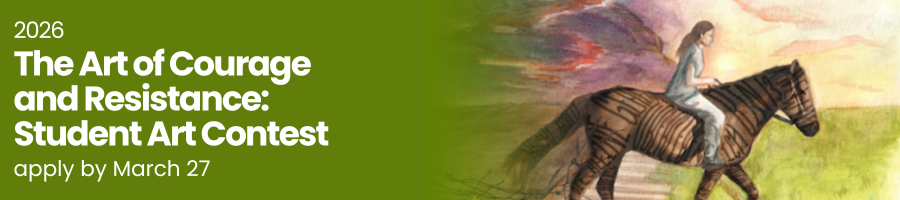
The Art of Courage and Resistance: Student Art Contest
The Art of Courage and Resistance: Student Art Contest challenges students to explore the history and personal stories of the Holocaust and to consider how these stories connect to our lives today.
Open to students in grades 5-12 from Washington, Idaho, Montana, and Alaska. The Holocaust Center for Humanity's Art Contest is offered in memory of Jacob Friedman, a Holocaust survivor who recognized the incredible value of education.
Prizes are awarded in three categories:
- Category 1 - Grades 5-6
- Category 2 - Grades 7-8
- Category 3 - Grades 9-12
Congratulations to our 2026 winners!
Category 1 - Grades 5-6
- 3rd: Yuna Boo - Grade 6, Rose Hill Middle School in Redmond, WA
- 2nd: Elliot Jackson - Grade 6, Peperzak Middle School in Spokane, WA
- 1st: Etty Cramer - Grade 6, Evergreen Middle School in Spokane, WA
Category 2 - Grades 7-8
- Honorable Mention: Payton Fortner - Grade 8, Salk Middle School in Spokane, WA
- Honorable Mention: August Walowski - Grade 8, St. Thomas School in Medina, WA
- 3rd: Melody Wyrick - Grade 8, Northwest Christian School in Colbert, WA
- 2nd: Edie Bangle - Grade 8, Salk Middle School in Spokane, WA
- 1st: Sophia Shen - Grade 8, St. Thomas School in Medina, WA
Category 3 - Grades 9-12
- Honorable Mention: Ayla Sibay - Grade 10, The Downtown School in Seattle, WA
- 3rd: Thea Sima - Grade 12, Tesla STEM High School in Redmond, WA
- 2nd: Paisley Archer - Grade 12, Lewis and Clark High School in Spokane, WA
- 1st: Reese Rudin - Woodinville High School in Woodinville, WA
See all their winning art work here!
Navigate directly to a subtopic:
2026 Prompt | Prizes & Categories| Rules & Requirements | How to Enter
Prompt
Background:
“I was 18, 19, 20. I was not married. I did not have any responsibility–only for myself–and that made a big difference...I felt I could help. I had the opportunity.” - Carla Peperzak
During the Holocaust, countless individuals and groups resisted Nazi oppression in ways both large and small. Resistance took many forms—armed uprisings, hiding and protecting others, preserving cultural and religious identity, writing, creating art and music, or even secretly documenting the truth so that future generations could learn about the atrocities being committed in the hope that such evils would never again occur against anyone. These acts of courage often came at great personal risk, yet they represent the resilience of the human spirit in the face of injustice and dehumanization.
Prompt:
Holocaust survivors rebuilt their lives in communities all over the world. Our Survivor Encyclopedia contains stories, video clips and photos about the experiences of Jewish Holocaust survivors who ultimately relocated to Washington State. Choose from among the below list of survivors to learn how courage and resistance played a role in their survival story. Your art should convey one or more aspects of a survivor’s story that best illustrates the theme of resistance.
Include a short artist’s statement (no more than 150 words) explaining:
- what specific art technique/s you used (eg., painting, drawing, digital painting, pixel, digital collage, etc. – no AI!)
- what your art represents;
- why you selected the person and the image, scene or concept of courage and resistance that you did;
- and how this survivor’s story inspires you when considering your opportunities today to resist, including educating others about injustice
Here are survivors in the Encyclopedia (links to their entries are included) whose stories clearly demonstrate one or more examples of resistance:
- Fanny Wald
- Paula Stern
- Carla Peperzak
- Laureen Nussbaum
- Martin Metzon
- Ed Kaye
- Thomas Blatt
- Ada Van Esso
Prizes & Categories
Entries will be judged in the following three groups with three prizes available for each.
Grades 5-6 Art
First Prize - $200 | Second Prize - $100 | Third Prize - $50
Grades 7-8 Art
First Prize - $200 | Second Prize - $100 | Third Prize - $50
Grades 9-12 Art
First Prize - $200 | Second Prize - $100 | Third Prize - $50
Winning entries will be displayed at the Holocaust Center, at events, and in publications throughout the year. Winners will be honored at our annual Yom Hashoah Community Program, April 12th, 2026
Rules & Requirements
Submissions due Friday, March 27th, 2026, at 11:59 PM (PT). Submission Guidlines:
All entries must be original (no AI) and respectful to the historical subject. This includes no depictions of graphic violence or of Hitler. The use of any swastika is strongly discouraged, unless it is not in any way prominent and is absolutely necessary to show what is being portrayed.
For other submissions guidelines and information about this year’s Contest, see:
| RULES | RUBRIC | FAQ'S |
Recommended Resources:
About the Holocaust.
- Survivor Voices (25 minute film by Holocaust Center for Humanity) (grades 7 and up)
- Path to Nazi Genocide (37 minute film by USHMM) (high school)
- Introduction to the Holocaust (USHMM Encyclopedia article)
About Resistance.
- Jewish Resistance (USHMM Encyclopedia) (article)
- Rescue and Resistance (USHMM Encyclopedia) (article)
- Jewish Resistance (Echoes & Reflections) (lesson)