




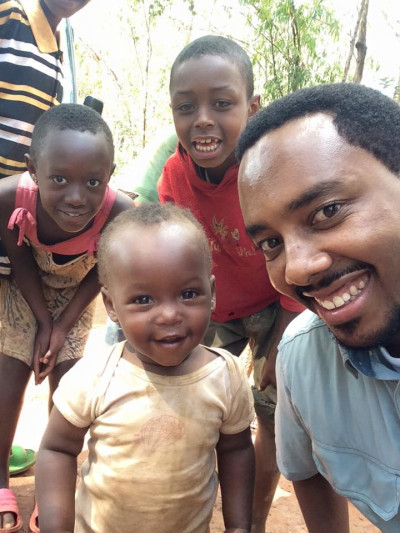
In 1959, at a time of political unrest in Rwanda, Paul Karemera’s grandparents on both sides of his family left their homes in Rwanda and became refugees in neighboring Uganda.
They belonged to the Tutsi tribe – the group targeted in the Rwandan genocide. Throughout the 1960s through the early 1990s, tribal tensions flared back in Rwanda. Paul, his siblings, and parents remained refugees in Uganda.
As a young student, Paul was harassed and bullied as an outsider in Uganda, despite having been born there. When civil war and then genocide gripped Rwanda in 1990-1993, Paul’s father was active in transporting soldiers over the border of Uganda into Rwanda. These soldiers were part of the Rwandan Patriotic Front (RPF) that fought the genocide’s perpetrators and eventually took over the nation’s government.
At 16, shortly after the genocide against the Tutsi, Paul went back to Rwanda as a “returnee” to the country. Many friends and family had not survived. Paul’s next years involved attending an English language high school and settling into life in Rwanda, which was not easy for him. Nationwide, the genocide’s wounds were still raw. Gacaca courts for restorative
justice were instituted, but many Hutu perpetrators were never apprehended.
Paul has been an English interpreter and travel guide since 2000. In 2009 Paul and his wife, Shelly, founded a travel company, Intore Expeditions, in Rwanda. He now splits time between Seattle and Rwanda. Paul wants students and other audiences in the United States to learn more about Rwandan history and the genocide.
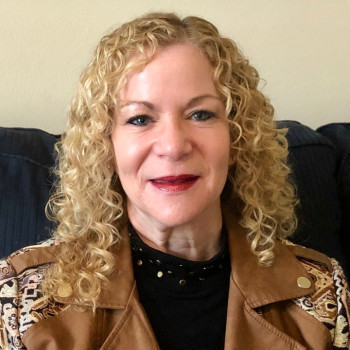
Betsy Touriel-Kapner, the daughter of Austrian Holocaust survivors, tells the stories of her parents escape from Austria to Bolivia.
Betsy Touriel-Kapner’s maternal grandparents, Gisela and Friedrich Aschkenasi, lived in Vienna, Austria, where they were married in 1924. Their daughter Gerda was born in 1932. In March 1938, the Nazis annexed Austria (an event termed “the Anschluss”) and soon enacted laws to strip Jews of their citizenship and careers. Jewish children, like Gerda, could no longer attend school. Betsy’s grandfather was sent to Dachau concentration camp, then Buchenwald, with other Austrian Jews who were prominent community members or businessmen. Gisela sold most of their belongings to bribe her husband out of Buchenwald.
The family of three managed to leave Austria by ship at the eve of World War II, traveling to Italy, then Chile, and overland to Bolivia with a visa from the Bolivian consulate. A German mining baron, Mauritz Hochschild, who operated tin mines in Bolivia, had convinced the Bolivian president to offer visas to Jews facing persecution in Austria and Germany. Some of these refugees, like Betsy’s grandparents, stayed in Bolivia permanently. Her grandfather became vice president of the mines run by Hochschild – who overall helped save nearly 20,000 Jews.
Betsy’s mother Gerda spent the rest of her childhood in Bolivia and attended high school and college there. Gerda travelled to Seattle to visit family in the 1950s, when she met a local man, Gabriel Touriel, who soon became her husband. They made their home in Tacoma, where Betsy and her brothers were born and raised.
After retiring from a career in the aerospace industry, Betsy felt a responsibility to share the story of her relatives and their unusual escape from Europe. Her grandparents and mother were refugees in South America, and her mother was later an immigrant to the United States. Their experiences of courage and rescue offer enduring lessons of resilience. Since 2020, Betsy has been a member of the Holocaust Center for Humanity Speakers Bureau, telling this family history to students and community members.
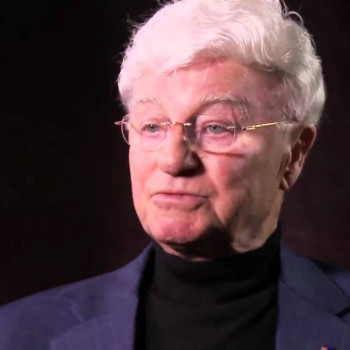
Henry Friedman was born in 1928 to a Jewish family in Brody, Poland (present-day Ukraine). When the Nazis invaded Brody in 1941, they swiftly deprived Jews of their basic rights. One day in February 1942, a young woman named Julia Symchuck ran to the Friedman’s house and warned Henry's father that the Gestapo was coming for him. Thanks to Julia, Henry’s father was able to flee. In the fall of 1942, the Nazis forced the remaining Jews in the area into a ghetto in Brody. Henry, his mother, his younger brother, and their female teacher hid in a barn owned by Julia Symchuck's parents. The Friedmans remained in hiding for 18 months, freezing and slowly starving as food became scarce. Finally, in March 1944 they were liberated by the Russians. Julia Symchuck was later recognized as Righteous Among the Nations.
Henry helped found the Holocaust Center for Humanity in 1989 and is an active member of the Speakers Bureau.
"When I was in hiding, I feared I would be the only Jew who survived. A terrible empty feeling came over me at the loss of so many cousins, and I felt as though I were standing all alone in a huge stadium." - Henry Friedman
Survivor Encyclopedia: Washington State - Henry Friedman. Read more about Henry, view photos, and watch video clips.
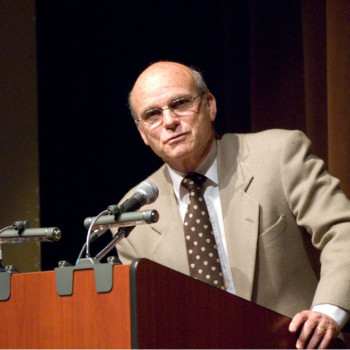
Peter was born in Amsterdam in 1935. In 1942, when Peter was 7, the Nazis seized Peter's entire family except for Peter and his mother. Peter's mother contacted the Dutch Underground for help. The Underground found Klaas and Roefina Post who agreed to shelter Peter and his mother on their small farm in northern Holland, putting their own lives at risk. For two years they lived with the Posts until it became too dangerous and they found another hiding place with two women in The Hague. Peter, his mother, and his aunt were the only survivors of his family. Klaas and Roefina Post have been recognized as Righteous Among the Nations by Yad Vashem.
After the war, Peter and his mother immigrated to the United States in 1949, arriving in New York. Peter was 13 and didn't speak any English, but was placed in the 8th grade. Peter had a long career as a radiology technologist. He and his wife Bea raised two children from Pete's previous marriage and had a third son in California. The Metzelaars moved to Seattle in 1997. Peter continues to be an active member of the Holocaust Center for Humanity's Speakers Bureau.
"My mother and I slept together in a bed that was inside a closet. I remember lying in that bed trembling in fear at times." - Peter Metzelaar
Survivor Encyclopedia: Washington State - Peter Metzelaar. Read more about Peter, view photos and watch video clips.
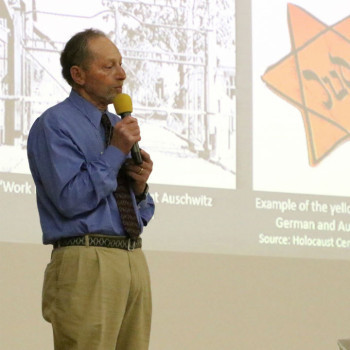
Joe Lewinsohn was born in Berlinchen, Germany on May 16 , 1937. On Kristallnacht (November 9-10, 1938), the family’s store was vandalized. His father Edwin and 10,000 other Jewish men were arrested and spent weeks in Buchenwald, a German concentration camp. In 1939, scared for their lives, the Lewinsohns fled Germany for Shanghai, their only option. For six years, Joe’s family shared a room with three other refugee families in the decrepit Shanghai ghetto. When the war ended, they went to Chile to live alongside over 10,000 Jews who had spent the wartime years there.
Determined to make a better life for the family, Joe’s mother Berta joined her brother Leo in Seattle in 1947. Leo had accompanied the family in 1939 when they fled to Shanghai, but he was able to continue to America. In 1949, the rest of the family joined Berta, sponsored by Seattle bakery owner Harry Lippman. Joe graduated from Garfield High School and joined the Army. Upon his discharge, he earned Bachelors and Master’s Degrees from the University of Washington and began a teaching career in the Seattle School District that would last 35 years. He married Janet Altaras in 1965, and they have two sons (Joel and Peter), numerous grandchildren, and a dog named Mollie. Since 2017, Joe has been a member of the Holocaust Center for Humanity's Speakers Bureau. As a refugee himself, Joe finds it important to reach out to students in similar situations.
Survivor Encyclopedia: Washington State - Joe Lewinsohn. Read more about Joe and view photos of Joe and his family.
Page 3 of 20