






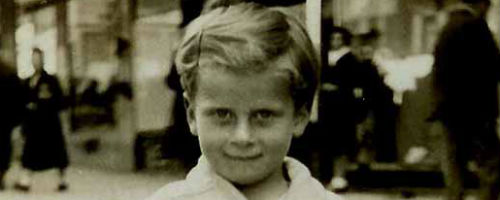
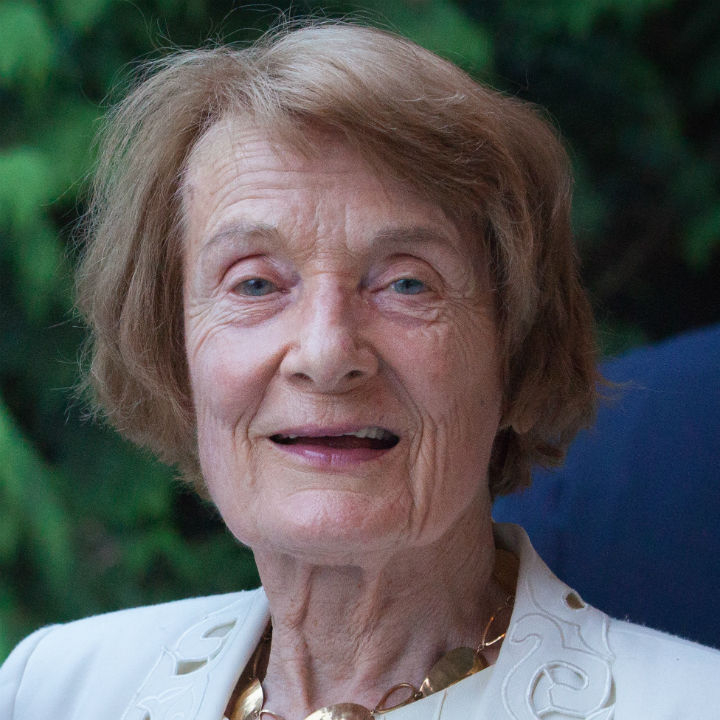
 Andrea and Joanna D’Asaro and their mother Barbara Sachs D’Asaro tell the story of Barbara’s childhood in Nazi Germany, and her escape as a young girl.
Barbara was born Bärbel Sachs near Rostock, Germany on August 18, 1927. She was adopted by a Jewish couple, Erich and Johanna Sachs, who lived in Berlin.
When Hitler came to power in 1933, the Nazi regime made life increasingly difficult for Jews in Germany. As a result, Barbara’s parents bribed officials to destroy documents about her adoption, which noted that a non-Jewish child had been adopted into a Jewish family. Barbara lived a happy childhood as her parents attempted to protect her from the growing danger they faced. Despite their best efforts, Barbara was still exposed to Nazi propaganda. She experienced the rapid takeover of Nazi ideology and policies into everyday life, including schools and youth organizations.
With the escalation of persecution in Germany, Barbara’s parents decided that for their family’s safety, it would be best to leave the country. Although Barbara’s status, being non-Jewish by birth, may have been safe, her parents’ certainly was not. They were able to find two sponsors in New York City who would support them in their move to the United States.
The Sachs family arrived by ship in New York harbor in 1938 and began to build a life in New York City. Barbara attended Oberlin College in Ohio and later Cornell University. At Cornell, Barbara met her future husband Arthur D’Asaro, and they married in 1953. Barbara and Arthur had four children. Barbara used a master’s degree in Nutrition to direct health oriented classes, and Arthur used his doctorate in physics in his job at Bell Laboratories in New Jersey. Barbara’s parents had some relatives who scattered all over the world due to the Holocaust, and others who were murdered by the Nazis.
In 2017 Andrea, a teacher, helped Barbara put her family story together into a presentation for classrooms. With the help of the Holocaust Center, Barbara, Joanna, and Andrea are now part of the Speakers Bureau to share Barbara’s unique experience during World War II.
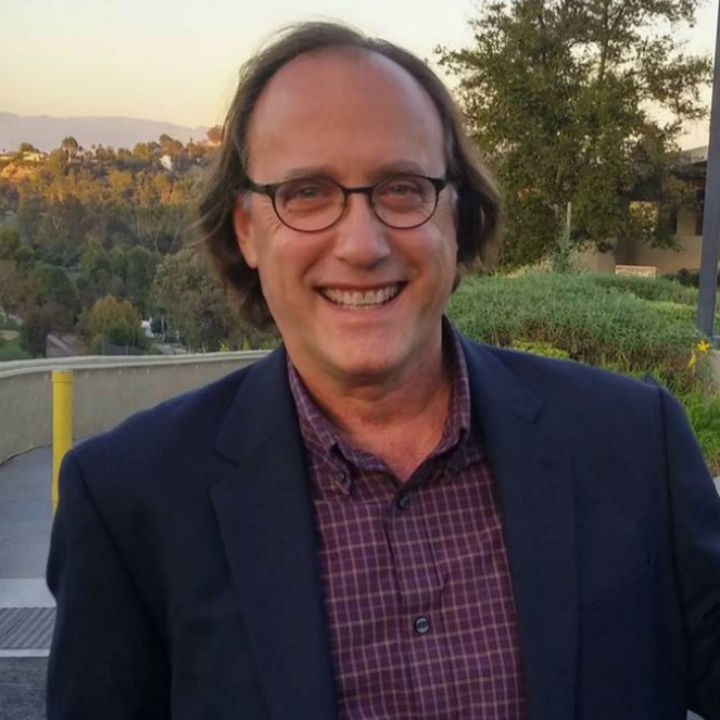
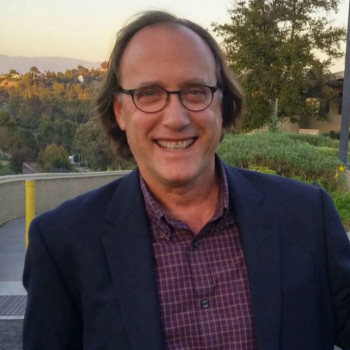 Ron Gompertz tells the story of his father, Rolf Gompertz. Ron is proud of his family heritage, and decided to research his father’s story so that he could help reach students who were studying the Holocaust. Ron tells his father’s story through video clips of his father telling about his own life, along with photos and documents that accompany his family research.
Rolf was born in Krefeld, Germany in 1927. Krefeld served as a hub for surrounding Jewish communities. Before 1933, there were 1,500 Jewish people living there. In 1933, when Rolf was only 6, the Nazi Party gained power in Germany.
Rolf’s memories include the fateful night of Kristallnacht on November 9, 1938. Nazi soldiers banged at the door of his parents' apartment demanding to be let in. They stormed into the apartment ready to arrest Rolf’s father. Rolf’s father ran into his office and pulled out his Iron Cross medal for valor in World War I.
Luckily, this time the Nazis left, but 30,000 Jewish men were arrested in the next few days.
The Gompertz family was fortunate to find a distant relative in Los Angeles who provided them with an affidavit to sponsor the family. They arrived in Los Angeles in June of 1939, just a few months before war broke out between Germany and Poland and deportations of Jews began.
Rolf entered the United States as a refugee. He started school in sixth grade barely speaking English, but grew up to be a journalist and author. He returned to Krefeld in 1987 to tell his story to adults and students. Rolf has also told his story to students in Los Angeles.
Rolf is very proud that his son, Ron, has decided to continue his mission of educating students about the Holocaust as a member of the Holocaust Center for Humanity Speakers Bureau.
Ron himself works in the Seattle area in the tech industry. In 2017, he published the novel Life's Big Zoo.
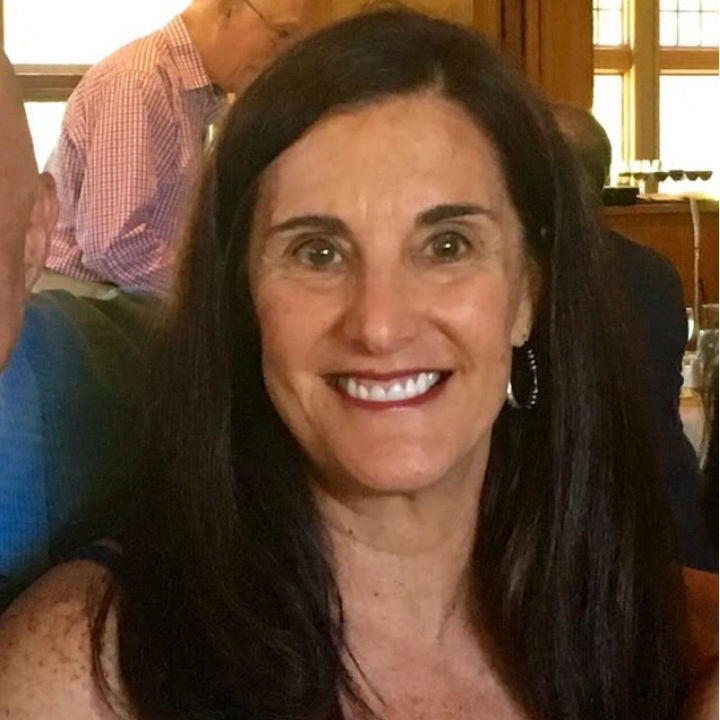
 Randee Kissinger's mother was a cousin of Vera Frank Federman's husband. Vera was born June 27, 1924. She grew up in Debrecen, Hungary as an only child, but with a large extended family. She studied both English and German and graduated from a girls’ high school.
On March 19, 1944 the Nazis occupied Hungary and soon thereafter deprived Jews of their civil rights. The Nazis, assisted by the Hungarian Arrow Cross, forced Jews out of their homes, businesses, and schools and into ghettos. Vera and her family, including her best friend and cousin, Marika Frank, were rounded up into the Debrecen ghetto along with the remaining Jewish population of their town. After several months in the ghetto and doing forced labor in a brick factory, they boarded cattle cars to Auschwitz Concentration Camp. It was June 27th 1944, Vera’s 20th birthday.
Vera was in Auschwitz for six weeks before the Nazis sent her to a munitions factory in Allendorf, a sub camp of Buchenwald, where she was a slave laborer. American forces liberated her there on March 28th, 1945. When Vera spoke later about this factory, she said that whenever they could, she and her friends did not fill the bullets with gun powder.
Vera was the only surviving member of her immediate family. After the war, she came to Seattle on a scholarship from the Hillel Foundation to attend the University of Washington. She married Marvin Federman and had two children.
Vera was a member of the Holocaust Center’s Speakers Bureau for many years. Vera passed away in 2017.
As a relative of Vera’s husband, Randee was always interested in Vera’s story . After Vera passed away, Randee decided that she wanted to tell her cousin’s story to students in the Pacific Northwest. Utilizing two testimonies by Vera at the Holocaust Center, Randee and the Center worked to develop a presentation using Vera’s video clips. Randee is currently a teacher at Maywood Middle School in Renton, WA where she teaches the Holocaust. She became a member of the Speakers Bureau in 2018.
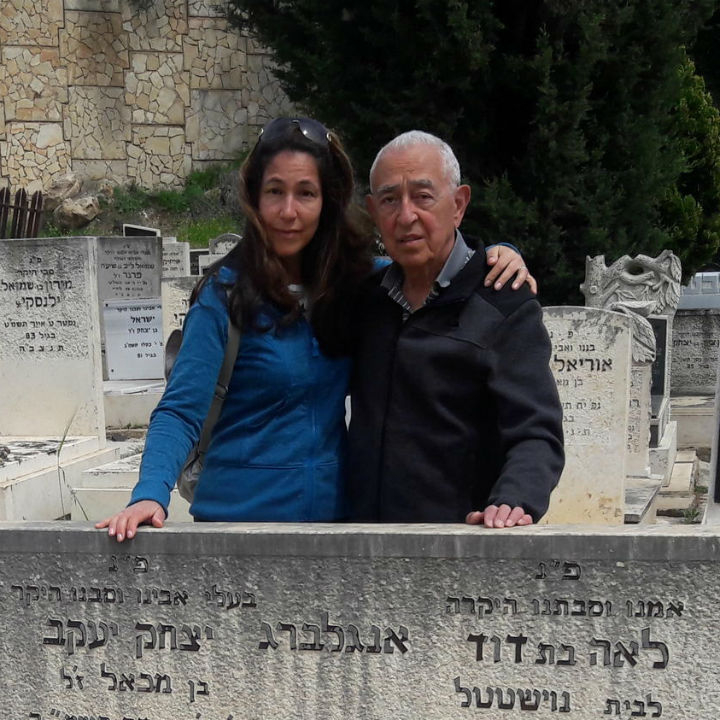
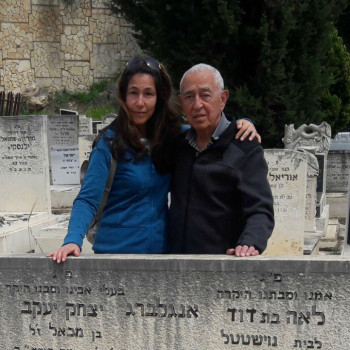 Michal’s father, Arieh Engelberg, was born in Tanobrezg, Poland in 1934. “I am the daughter of a Holocaust survivor. There are many and different Holocaust survivor stories. My family was expelled from their home town of Tarnobrezg, Poland where they had resided for generations. My family was expelled for one reason only – because they were Jewish. They were not alone. Thousands of Jews were expelled from Polish towns – where did they go? How did they know to go there? How did they survive? This is the story of my family.”
In 1939, when Arieh was only 5 years old, Germany invaded Poland. As part of the Molotov-Ribbentrop Pact, dividing Poland between Germany and the Soviet Union, Polish Jews living close to the dividing line with the Soviet Union in Poland were forced to leave their homes.
Arieh’s family decided that it would be safest to move east into the Soviet Union with the hope that they would be able to return to their home soon. Instead, they became part of a migrant group sent to various labor camps as far away as Siberia. When the war ended, they were loaded onto railcars and sent back to Poland. They applied for visas to Israel, which were granted in 1950.
The Engelberg family traveled over 12,000 miles between 1939 and 1950 escaping the Holocaust.
In Israel, Arieh served in the Israeli Defense Forces and became a mechanical engineer. He married Michal’s mother, Sarah, in 1964. In 1975 Arieh moved to Vancouver, BC, accepting a job as an off-shore and sub-sea engineer. In 1976 his wife and family joined him.
“My father’s family was propelled into a life they didn’t wish for and had no control over. With the help of the Holocaust Center for Humanity, my father’s oral and written testimonies and his school certificates, I was able to trace my family throughout the war. My father’s school certificates became important historical documents to unravel my family’s route as dictated by the communist regime.”
With primary sources, maps, and her father’s video testimony, Michal brings life to her family history.
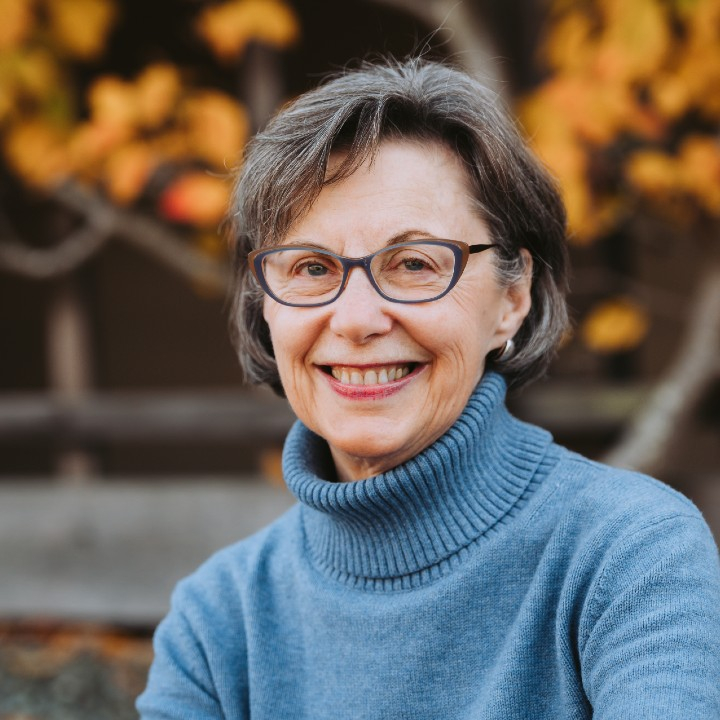
Beverley Silver shares the story of both of her parents, Jewish Holocaust survivors Johanna Stern Moss and Malcolm Moss.
Beverley’s mother Johanna was born in Germany in 1925. As the Nazis came to power, her grandmother, Anna Stern, feared for her granddaughter’s life and made arrangements for Johanna to escape Germany on a Kindertransport.
Leaving her father, grandmother, and extended family, Johanna sailed to England in 1939, where she and 24 other refugee girls lived in a hostel sponsored by a Jewish refugee committee in the town of Middlesbrough. Johanna’s father managed to escape to the United States shortly before World War II broke out. It was too dangerous during wartime, however, for Johanna to travel across the Atlantic Ocean to join him. Instead, Johanna remained in Middlesbrough living with a loving and generous English family, the Levys. Finally, in 1946 she arrived in the United States and was reunited with her father, but tragically, many of her relatives were killed in the Holocaust.
Beverley’s father Malcolm was born Moizesz Moskiewicz in Poland in 1912 to a large Jewish family. He graduated from the Vienna Academy of Design with an ambition to become a clothing designer. Fearful of an impending German invasion of Poland, Malcolm fled to Switzerland in 1938, where, after World War II began, he was interned in a labor camp for Jewish refugees. Malcolm immigrated to the United States in 1945 and joined his brother, his only relative who survived the Holocaust.
Johanna and Malcolm met and married in New York in 1946. Malcolm continued his career as a clothing designer in the United States, and he and Johanna raised three children in New York and Illinois before retiring to San Diego. Malcolm passed away in 1986 and Johanna in 2019.
Beverley Silver spent her career as an art educator, working extensively in K-12 public and private schools, museum, and university settings. Beverley retired in 2021 from Seattle University, where she directed the Job Placement Office in the College of Education. She enjoys spending time with her children and grandchildren, and became a member of the Holocaust Center Speakers Bureau in 2022 with the hope of keeping her parents’ legacy of survival alive.
Page 17 of 20