





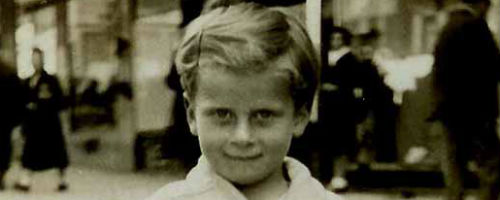
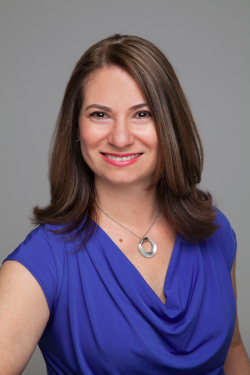
 Daphna Robon tells the story of her parents, Imre Friedmann and Naomi Kraus.
Imre was born in 1921 in Budapest, Hungary. Higher education was always his goal, but by the time he was ready for college in 1939, it was almost impossible for Jews to attend university in Hungary due to antisemitic restrictions. He finally enrolled in a university where he endured terrible discrimination from both students and professors. In 1944, Hungary was invaded by the Nazis, and Imre, like many Jewish men, was forced into hard labor. Luckily, he survived the labor camp and was later saved from being deported to a concentration camp by a very courageous person who impersonated a guard. After World War II, Imre escaped from Hungary to Vienna where he received his PhD in botany, zoology, and philosophy. He later immigrated to Israel where he became a professor at Hebrew University in Jerusalem.
Naomi was born in 1933 in Budapest, Hungary. She was hidden in Budapest during the Holocaust, first in a Swiss “safe house,” then with a family, using a false identity, thanks to courageous non-Jewish upstanders. After the war, Naomi was united with her mother in Budapest and finished high school. She then escaped Hungary to Vienna and later immigrated to Israel.
Naomi and Imre met in Israel on a blind date and married in 1953. Naomi, as the spouse of a faculty member, could enroll for free at Hebrew National University where she received a PhD in biochemistry. Later, the couple immigrated to the United States and became highly successful professors in their fields of science. Imre became quite well known in his field and is mentioned in Carl Sagan’s famous book Cosmos. He was featured in National Geographic and Discover magazine, amongst others.
Daphna was born in Israel and spent most of her childhood years in Houston, Texas. She was a lawyer and worked in insurance before changing careers to become a real estate broker, which she continues till today. Daphna lives in the Seattle area with her family and began sharing her family story as a Holocaust Center speaker in 2021. Her presentation is filled with primary source documents and video clip testimonials of her parents. Daphna has a strong passion for doing what she can to stop antisemitism and racism. Daphna dedicates her presentation to her Grandmother Gizi, one of her strongest supporters throughout her life, and the person who taught her what it means to be resilient.
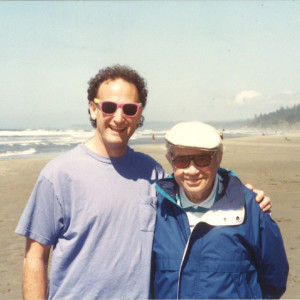
Tom Heller, MD, is the son of Holocaust survivors.
Tom’s father Paul was born in Chomutov, Czechoslovakia (now Czech Republic) in 1914. As a young student, Paul was the only Jewish student in his class. He attended Charles University and medical school in Prague and graduated in 1938. In March 1939, Nazi Germany invaded and annexed Czechoslovakia. Dr. Heller was poised to leave the country for England, but on the first day of WWII – September 1 – was arrested by the Gestapo for anti-Nazi activity connected to a university group.
He was detained as a political prisoner, sent to Dachau and Buchenwald concentration camps, where he spent 3 ½ years doing hard labor, and then to Auschwitz in 1943. Exploiting his skills as a physician, Dr. Heller was sent by the Nazis to work at a clinic in sub-camp Jawarzno. Dr. Heller was a part of a death march to Gross-Rosen concentration camp before being transported back to Buchenwald in February 1945. Liberation finally came that April. World-famous reporter Edward R. Murrow visited Buchenwald on April 12, and in a live broadcast several days later mentioned Dr. Heller, thus notifying his friends and family that he was alive.
Tom’s mother, Liese Florsheim, was from Germany and had met Paul at Charles University in the 1930s. She was able to escape to the United States in 1938, where she earned a Master’s degree in Social Work. Liese was at the dock to meet Paul when he arrived in New York in 1946 and they were soon married. Dr. Heller became an internationally recognized medical researcher in blood diseases while raising Tom and daughter, Caroline, with Liese.
Tom also became a doctor, and worked for many years in Seattle in a community health center, and subsequently for the U.S. Centers for Disease Control, helping establish HIV treatment services in countries in Asia and Africa. Now retired, he chose to share his family story to help teach students and other audiences the dire consequences of prejudice and hate. Tom joined the Speakers Bureau in 2022. He has three grown children and lives with his wife in Seattle.
Image: Tom Heller with his father Paul in 1994.
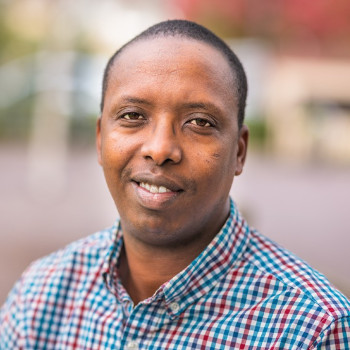
Emmanuel Turaturanye is a survivor of the 1994 Rwandan genocide.
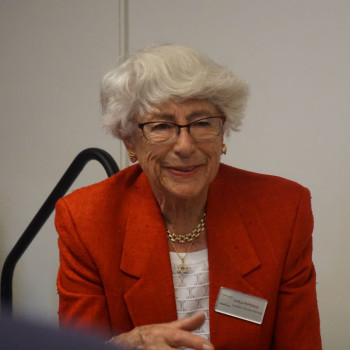
Carla Peperzak was born in Amsterdam in 1923 to a Jewish family. Although Carla's mother was not born Jewish, she had been adopted by a Jewish family, and as a teen and adult came to embrace the faith. Carla was a typical youth of the time. She played field hockey, skated on Amsterdam’s canals, and went to parties. She also attended synagogue and Hebrew school where one of her fellow students was Margot Frank, the older sister of Anne Frank. In 1940, the year Carla graduated from high school, Germany invaded the Netherlands. By 1941 the Nazis forced Dutch Jews to register with the state, and they were issued identification papers marked with a “J.” Thanks to a sympathetic SS member, and perhaps due to Carla's mother's background, Carla's father arranged to have her papers changed to remove the J.
That year, at the age of 18, Carla joined the Dutch resistance. She helped save her aunt, uncle, and two cousins, hiding them at a farmhouse in the Dutch countryside. Later, disguised as a German nurse, Carla rescued her young cousin from a train bound for Westerbork, a transit camp for Dutch Jews who were then sent to killing center s in Nazi-occupied Poland. Throughout the war, she continued to secure hiding places for Jews, published an underground newspaper, and created fake identification papers and ration cards. While Carla and her immediate family survived the Holocaust, 18 members of her family did not. In the aftermath of the war, she met her husband Paul, a Dutch Catholic. In the ensuing decades, Carla lived and traveled across the world with her husband, who worked for the United Nations. In 2004 she moved to Spokane and has been actively engaged in sharing her story as part of the Holocaust Center for Humanity's Speakers Bureau.
“I was 18, 19, 20. I was not married. I did not have any responsibility–only for myself–and that made a big difference...I felt I could help. I had the opportunity.” - Carla Peperzak
Survivor Encyclopedia: Washington State - Carla Peperzak. Read more about Carla, view photos of Carla and her family, and watch video clips.
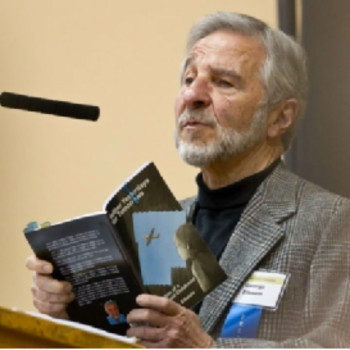
George Elbaum was born in Warsaw, Poland on August 20, 1938, one year before Hitler invaded Poland and spurred the outbreak of World War II. Within weeks, George's father was called to serve in the army and never returned. Acutely aware of the danger she and her son were in, George's mom dyed her hair blonde and purchased the identification documents of a Catholic woman who had died. In 1942, she smuggled George out of the Warsaw ghetto before paying various Polish Catholic families to hide and raise him. In 1945, George was reunited with his mother, the only other surviving member of his family. They immigrated to America in 1949.
For 60 years, George was reluctant to share his story with anyone. He worked towards an engineering career, earning an undergraduate degree, two Master's Degrees, and a Ph.D. from the Massachusetts Institute of Technology (MIT). In 2009, upon viewing "Paper Clips," a documentary chronicling a Tennessee middle school's unique attempt to honor Holocaust victims, George was moved to share his story with the world. He and his wife Mimi Jensen live in San Francisco, but George makes frequent trips to Seattle to visit his children and grandchildren. George is a member of the Holocaust Center's Speakers Bureau.
“I recognize that we who survived the Holocaust have a responsibility to tell our stories to give hope to the slogan ‘Never Again.’” - George Elbaum
Survivor Encyclopedia: Washington State - George Elbaum. Read more about George Elbaum, view photos of George and his family, and watch video clips.
Page 4 of 20